
Written by Gavriel Panayiotou, Industrial Design Manager, EnergyIntel
Quick Overview
- Parking areas are no longer passive spaces. They can become productive energy assets for businesses.
- PV parking canopies create double value: shaded parking and on-site solar electricity from the same commercial space.
- The roof is not the only solar opportunity. Parking areas can increase a site’s total energy potential, especially when roof space is limited.
- EV charging should be planned as part of the energy system, not as a separate add-on, because chargers create new electricity demand.
- The strongest value comes from integration. PV canopies, storage, smart charging and monitoring working together around the business’s real energy needs.
PV canopies can turn commercial parking into shaded, electricity-producing infrastructure. Their real value comes when solar generation, EV charging, storage and monitoring are designed around the business’s actual energy demand.
For most businesses, the solar discussion begins with the roof. It should not end there.
A commercial parking lot is often one of the largest unshaded surfaces on a business property. It sits beside the building, receives sunlight throughout the day and occupies land the business already owns. Yet, from an energy perspective, it usually does nothing.
A PV parking canopy changes that.
It provides shade for employees, customers, visitors or fleet vehicles while generating electricity for the building’s daytime operations. The same space performs two functions: it improves the parking environment and becomes a productive energy asset.
In Cyprus, where strong solar production often coincides with high daytime electricity demand, that is a commercial opportunity businesses should not ignore.
The Roof Is Only the Beginning
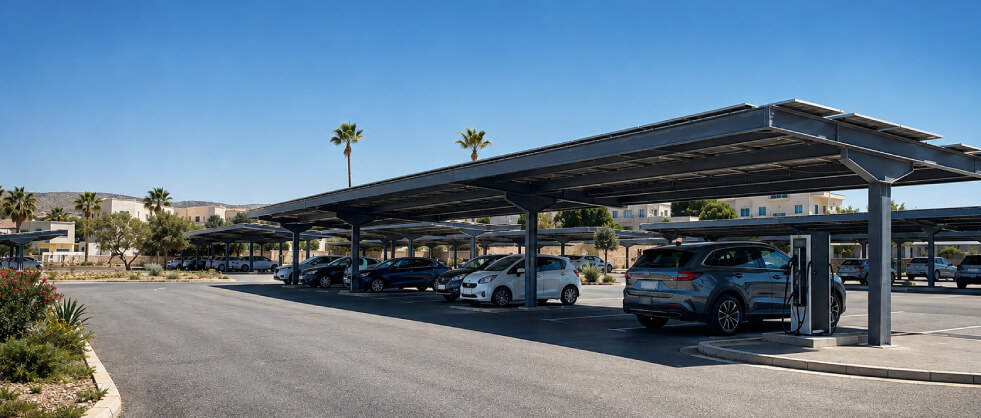
Rooftop PV is usually the first option considered, but not every roof can support a business’s full solar potential.
Available space may be restricted by shading, equipment, structural limitations or future expansion plans. Some roofs are already in use. Others simply cannot accommodate enough capacity to make a meaningful difference to the site’s total energy demand.
A PV canopy adds another productive layer without requiring additional land. It allows the business to generate more electricity from its existing property footprint while creating a useful structure below.
This makes the parking lot more than a construction feature. It becomes part of the business’s long-term energy infrastructure.
The Business Case
Consider a commercial car park capable of supporting a 100 kWp PV canopy.

Actual performance depends on design, orientation, shading, technology, maintenance, site-specific tariffs, consumption patterns, financing, self-consumption and regulatory conditions.
These are not marginal numbers. They can materially affect a business’s operating costs and the return generated by property it already owns.
But the value of a PV canopy is not determined simply by how many panels can fit above the cars.
It depends on how well the system is designed around the business.
Design Around Demand
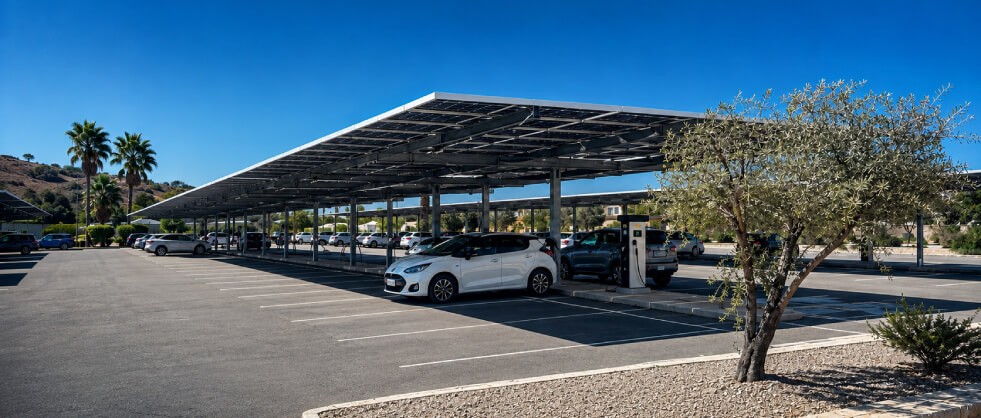
The strongest value usually comes when the electricity produced on-site is also consumed on-site.
This is particularly relevant for commercial buildings with substantial daytime demand. When solar generation coincides with cooling, equipment and operational loads, the business can reduce its reliance on grid electricity during working hours.
That is why the design process must begin with the site’s actual load profile:
• When does consumption peak?
• How much daytime demand exists?
• Which loads are essential?
• Can consumption be shifted?
• Would battery storage add value?
• Is EV charging planned?
The difference is fundamental. One approach installs panels. The other designs an energy asset.
EV Charging Changes the Equation
As electric mobility grows, commercial car parks will carry a new kind of demand.
PV-covered parking creates a natural location for charging employees’ cars, customer vehicles, tenant vehicles or commercial fleets. For offices, hotels, shopping centres and fleet operators, the same area can produce electricity and support mobility without requiring separate land.
But EV chargers are not simply amenities. They are significant electrical loads.
If several vehicles charge simultaneously, they can place additional pressure on the site. Smart charging and load management are therefore essential.
A coordinated system can distribute available power according to building demand, solar production, vehicle requirements and user priorities. Charging can be reduced when the building is under pressure and increased when solar generation is high or other demand is lower.
The canopy and the chargers should not be treated as separate projects. They are parts of the same energy system.
Storage and Monitoring
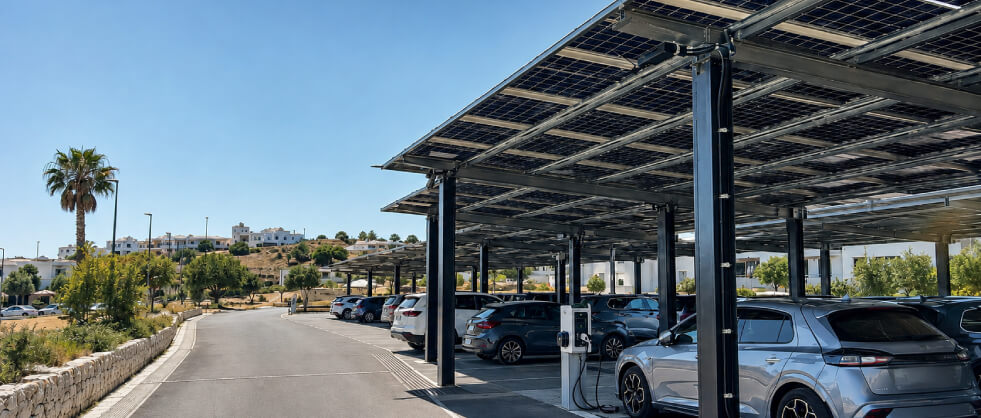
Battery storage can strengthen that system by retaining surplus electricity for use later in the day. It can improve self-consumption, support load shifting and reduce grid dependence during selected periods.
Monitoring provides the intelligence needed to manage it.
A business should know how much electricity the canopy produces, how much the building consumes, how much supports EV charging, how much is stored and how the system performs over time.
Without monitoring, the company owns infrastructure but has limited visibility. With it, management can decide when to expand capacity, add storage, adjust charging or respond to changing consumption patterns.
The technology is not only in the panels.
It is in how the entire system works together.
From Passive Space to Productive Infrastructure
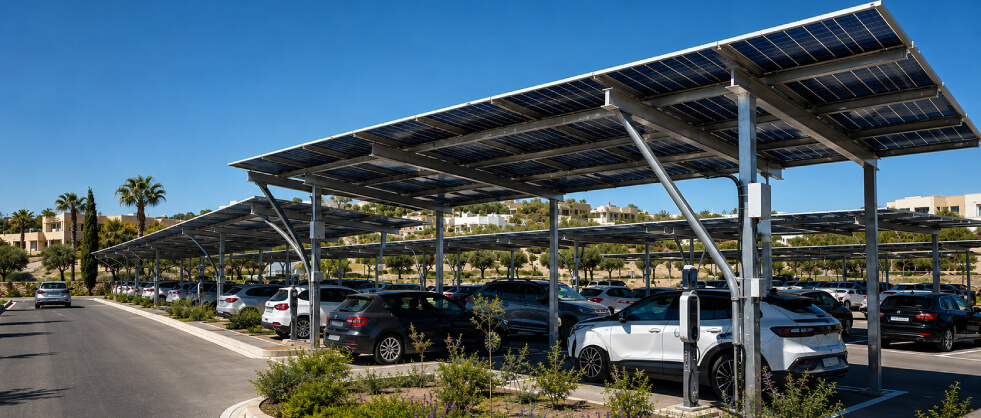
A parking lot already occupies the land. It already receives the sunlight. It already serves the daily movement of people, vehicles and operations.
The question is whether it will continue to provide parking alone or begin producing energy and long-term value for the business above it.
Turn your parking lot into infrastructure that works for your business every day.
Speak with EnergyIntel to assess its full energy potential.