
Written by Panayiotis Alexandrou, Sales Engineer, EnergyIntel
Quick Overview
- Off-grid systems are not suitable for everyone.
- They are ideal for remote locations or those seeking complete energy independence.
- They require careful planning and a higher initial investment.
- For most homes, hybrid systems offer a more balanced solution.
Off-grid solar systems are returning to the public conversation, not merely as an “alternative solution,” but as a deliberate choice for specific types of users. Yet there is still considerable confusion surrounding them: are they a viable solution for everyone, or are they intended for a select few?
The answer is not straightforward and it is certainly not “yes, for everyone.”
What Is an Off-Grid System, Really?
Unlike conventional solar systems, which are connected to the electricity grid, an off-grid system operates entirely independently. There is no connection to the Electricity Authority of Cyprus (EAC). Energy is generated by the solar panels, stored in batteries and consumed on-site.
This means one thing: every energy requirement must be anticipated in advance.
There is no safety net. If generation or storage capacity is insufficient, there is no external supply to fall back on.
Why Would Someone Choose One?
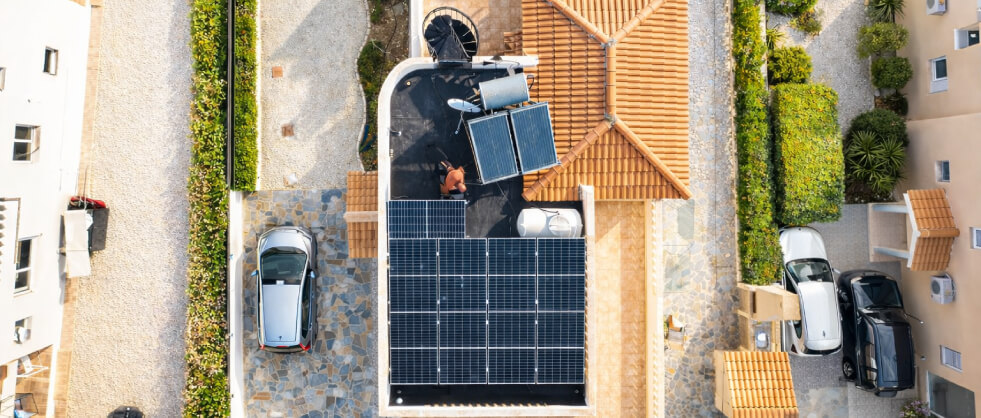
In a country such as Cyprus, where access to the electricity grid is widely available, choosing an off-grid system is not usually about saving money. It is more often a matter of necessity or strategy.
There are three main use cases:
1. Remote Homes or Developments
In areas where connecting to the grid is difficult or financially unviable, such as mountainous locations, agricultural plots or remote holiday homes, an off-grid system may effectively be the only practical option.
2. A Strong Need for Energy Independence
A growing number of property owners want complete control over their energy.
Their objective is not simply to reduce electricity bills, but to achieve:
- Zero dependence on the grid
- Protection against power outages
- Energy self-sufficiency under all conditions
In these cases, an off-grid system is not a necessity. It is a conscious choice, one rooted in a particular philosophy of independence and control.
3. Specialised Applications
From industrial facilities and strategic infrastructure to demanding hospitality developments, there are environments in which an uninterrupted energy supply is not a luxury, but an operational requirement.
In these settings, reliability takes precedence over every other consideration.
The Critical Factor That Is Often Underestimated
An off-grid system is not simply “a larger solar installation.”
It is a complete energy ecosystem that must be designed with precision, taking into account:
- Daily and seasonal energy consumption
- Peak demand
- Storage capacity
- Backup capacity for periods of low solar generation
For example, a residential off-grid system cannot be designed only around a “good” sunny day. It must also be capable of meeting demand during periods of low generation. This usually requires greater battery capacity and much more careful system sizing.
In other words, you are not simply purchasing equipment.
You are investing in certainty.
Is It Right for Everyone?
No.
And this is perhaps the most honest answer, one that is rarely stated clearly.
For a typical urban or suburban home in Cyprus with easy access to the electricity grid, a hybrid system, solar panels and battery storage combined with a grid connection, will usually meet most energy needs in a far more balanced way.
An off-grid system makes sense when:
- There is no access to the grid or
- You do not want to depend on it, regardless of cost.
The “Unspoken” Consideration
There is another dimension, however, that is not often discussed openly.
Complete energy independence requires not only the right technology, but also a significant investment.
This is not necessarily because the technology itself is expensive. It is because the system must be capable of covering every possible scenario, including the most demanding ones.
In a grid-connected or hybrid system, the electricity grid can act as a backup whenever solar generation and stored energy are insufficient. In an off-grid system, that backup must be built into the solution itself, through sufficient storage, careful design and, in many cases, additional equipment. This is the main reason the total investment is higher.
The Real Question
Perhaps, then, the right question is not:
“Should I install an off-grid solar system?”
But rather:
“How much energy independence do I actually need and how much is it worth to me?”
For some, the answer is clear.
For most, however, the optimal solution lies somewhere in between.
And that is where good system design makes all the difference.
One Final Step
If you are seriously considering energy independence, the decision should not begin with the equipment. It should begin with a clear understanding of your lifestyle, your consumption patterns and your actual energy needs.
A well-designed solution does not need to look impressive. It simply needs to feel exactly right.
If you would like to explore what a system tailored to your own requirements and energy profile could look like, let’s discuss it.
With a methodical approach, meaningful analysis and the level of precision that a decision of this importance demands.